Wildfire risk is not theoretical for anyone living along a treed ridge, beside a greenbelt, or near a patchwork of small acreages. All it takes is a week of dry wind and a spark to expose every weakness on a property. The first thirty meters around a home decide whether embers fizzle on gravel or find a ladder to the roofline. A safety buffer, designed and maintained with FireSmart Tree Services, turns that vulnerable ring into a shield.
I have walked hundreds of yards with property owners who loved their trees but lost sleep when the Chinook winds kicked up or a neighbor’s burn pile flared. The good news, learned the hard way on real sites, is that you do not have to strip your place bare. You have to think like fire travels, then change the fuel, the spacing, and the structure of your trees. That is where a certified arborist’s judgment pays for itself.
What FireSmart really means for a treed property
People often equate FireSmart with raking needles or stacking firewood farther from the deck. Those are pieces of the puzzle, but the most impactful work lies in how you manage the vertical and horizontal continuity of fuels. Embers do most of the damage in residential settings. They ride the wind, land in receptive fuel, then climb.
A safety buffer reduces two things. First, the chance that an ember can find fine, dry fuel near the house. Second, the number of pathways that let small flame become crown fire. The buffer is not just about removing trees. It is precise work, mixing Tree Pruning & Crown Shaping with selective Tree Removal Services, Stump Removal & Grinding so stumps do not keep smoldering, and sometimes Tree Cable and Bracing to retain significant trees safely rather than taking them down.
Reading your property like a fire would
A walkthrough starts at the foundation and works outward. In the first 1.5 meters from the home, anything that can catch, carries risk. Bark mulch under shrubs, decorative junipers, a wooden lattice that touches the ground, lawn chairs stacked for winter, even a splash of leaves against the garage corner, all of it is kindling.
From there to about 10 meters, the goal is to disrupt ladder fuels. Ladder fuels are the steps fire uses to move from grass to shrubs to low branches and up into crowns. If you can stand ten meters out and see a clean gap between the ground and the first live branches, you are on the right track.
From about 10 to 30 meters, you are working on spacing and crown structure. You still want to break up continuity, but you can keep more trees. In heavier stands, especially conifers with resin that burns hot, you open canopy clusters and prune crowns up. On broadleaf trees like aspen and maple, you are looking to keep strong, well distributed limbs and thin out weak laterals that can break in a windstorm and drop fuel.
A Certified Arborist Consultation should document all this. Expect measurements of canopy base height, crown separation, tree health, and defects that influence fall hazards. A good plan covers fuel reduction and tree safety together, not in separate silos.
How a professional assessment sets priorities
During a Dangerous Tree Assessment and Removal review, we evaluate targets and defects. Targets are the things that matter if something fails: the house, the driveway where you park, the play structure, the neighbor’s fence, the power line that cuts across the back lot. Defects include decay pockets, fungal conks, included bark at a co-dominant stem, a lean aggravated by root plate heave, or storm splits hiding in the canopy.
We score each tree by likelihood of failure and consequence. A healthy Douglas fir with a deep crown and five meters of lift might stay, especially if we can prune and thin for wind flow. A dead standing pine leaning toward the eaves with pitch tubes and woodpecker holes is a textbook removal. The goal is not to make the forest uniform. It is to reduce the few outsized risks that compromise the whole buffer.
On sloped ground, wind exposure and roll-out risk change how we cut. I have seen stumps that were left tall become ramps for rolling logs after a storm. Where terrain demands it, Stump Removal & Grinding is part of the prescription, because a hidden stump can smolder after a grass fire and reignite duff.
Pruning and crown shaping that actually slows fire
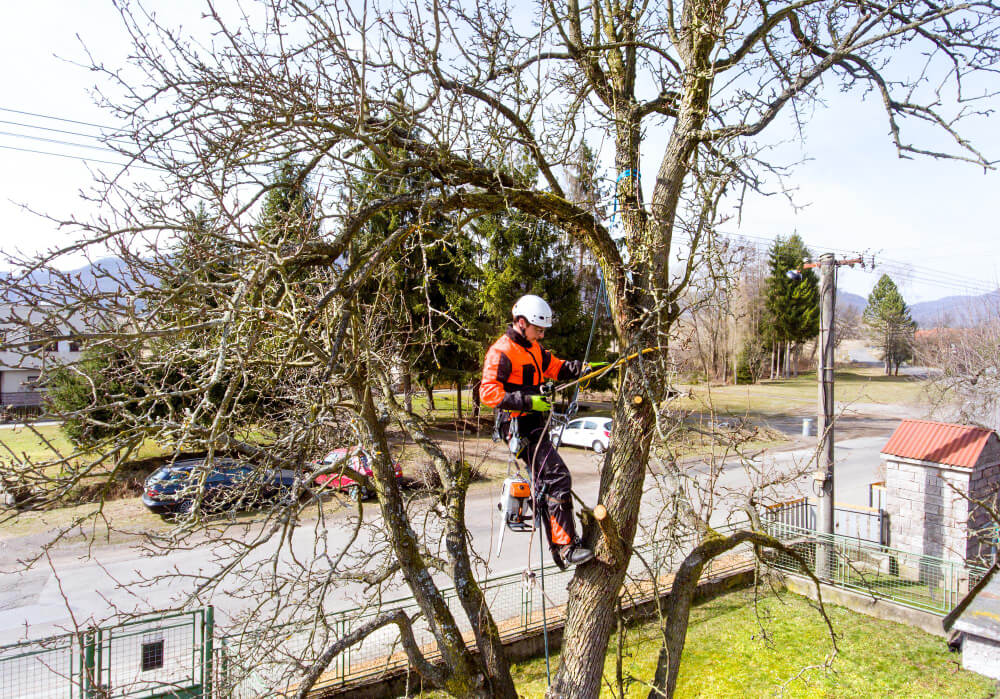
Tree Pruning & Crown Shaping for FireSmart is not the same as ornamental topiary. We lift crowns to a safe height without over-thinning, which stresses trees and invites sunscald. As a rule of thumb, we try not to remove more than 20 to 25 percent of live crown in a single season. On conifers, we raise the canopy base so flame has a taller vertical gap to cross. On deciduous trees, we reduce crowded interior wood and remove deadwood that would drop embers.
Crown shaping also matters for wind. A balanced, tapered crown sheds gusts, reducing broken branches that turn into future fuel. You can see the results on https://rentry.co/iksq49ii a late summer evening when the canopy moves as one rather than in frantic, clapping patches. Balanced load, fewer failures, less ground fuel to tidy each spring.
When removal is the right call
Sometimes Tree Removal Services are the simplest way to create breathing room. A line of closely spaced spruce along a driveway often acts like a wick. Taking out every second or third tree and pruning the rest can transform a hot, continuous wall into a mixed, wind-permeable screen. We weigh habitat and privacy with risk. If a tree is structurally sound but too close to the house, we might move a seating area and remove flammable shrubs, keeping the tree. If it has advanced decay or poor taper, removal beats repeated repair.
Felling near buildings is surgical work. We set drop zones, install tag lines, or dismantle by sections from the top down with rigging. A compact tracked lift can reach over gardens without shredding turf. After takedown, Stump Removal & Grinding clears the last fuel and opens room for non-combustible groundcovers. Where roots stabilize a bank, we might leave a low, flush-cut stump and cover with mineral soil rather than grinding, to protect against erosion.
Keeping signature trees with cable and bracing
Owners often ask how to keep a beloved tree that has a structural flaw. Tree Cable and Bracing can be the answer when used judiciously. Dynamic cabling supports co-dominant stems that might split, while brace rods reinforce cracked unions. The point is to reduce the chance of catastrophic failure, not to freeze a tree in place forever.
Cabling comes with obligations. We inspect hardware every one to three years, adjust for growth, and pair it with pruning to reduce lever arms. This is not a way to avoid all removal. It is a way to carry valuable canopy through to a safer condition while you reshape the stand around it.
The three working zones around your home
Although every property is unique, I often frame the buffer as three working zones. At the foundation, you want hardscape and plants with low resin and high moisture content. Between 1.5 and 10 meters, aim for tidy, well pruned trees with generous spacing and minimal litter. From 10 to 30 meters, manage the stand to break up continuous crowns and dense understory. If you own more land, extend that logic farther out, thinning and pruning to reduce intensity before it reaches the home site.
Think of it as creating room and time. Room for firefighters to work safely, and time for embers to burn out before they can find a pathway to something vital.
An afternoon on site, and the day after a storm
Two snapshots will make this real. On a south-facing lot above a lake, we met a couple who planted lodgepole pine for privacy twenty years earlier. The trees had grown into a dense screen right against a cedar-clad house. The first look told us everything. Duelling risks: wildfire and windthrow. We removed seven of the most crowded pines, pruned the rest to raise crowns to four meters, and underplanted low, broadleaf shrubs set in gravel. We ground the stumps, reused chips far from structures for a trail, and swapped bark mulch near the entry for crushed basalt. The place still felt private, but now light moved through the stand and a spark could not easily find a ladder.
On another site after an early October snow, a heavy, wet load snapped a bigleaf maple at an old, included union above a shed. The owner called for Emergency Tree Services at 6 a.m. We secured the site, dropped the compromised leader with a controlled swing, and assessed adjacent trees. Three had storm cracks you could not see from the ground. Those went into the Dangerous Tree Assessment and Removal queue that week. By the next wind event, that ring of failures was gone, and we had cabled a healthy companion maple to stabilize it through winter.
Why stump work matters more than people think
Old stumps are ember traps. In dry spells, punky wood at the core can smolder for hours. Stump Removal & Grinding clears those pockets and prevents suckering on species like poplar that push up shoots along roots, creating new ladder fuel. It also lets you fix grade and drainage. After a grind, we usually remove grindings within 5 to 10 meters of the structure, then add a few inches of mineral soil and compacted gravel near foundations. Chips work well farther out along trails or in garden beds away from buildings. Close to the house, non-organic surfaces win every time.
Working with your site, not against it
Every prescription runs through the filter of your soil, slope, and microclimate. On rocky sites with thin soil, aggressive thinning can shock residual trees and lead to blowdown. We might stage removals across two seasons, prune first to reduce sail, then remove selected stems later once the stand adapts.
On north slopes that hold moisture, fire risk can feel abstract until August. Yet that same moisture grows ladder fuels fast. Here, seasonal maintenance counts more than heavy one-time thinning. On exposed ridges, we might leave small, wind-hardy groups, trim crowns for flow, and avoid sudden, wide gaps that create turbulence.
Utilities and easements create their own rules. Clearances from service drops and underground lines dictate equipment choices and cut plans. Coordination with the utility can unlock cost sharing for hazard removals under their standards, especially when lines run through private woodlots.
Permits, costs, and neighbor coordination
Many municipalities regulate removals over a certain diameter or within riparian buffers. A Certified Arborist Consultation should include permit guidance and, if needed, a tree preservation plan for the building department. Costs vary widely, from a few hundred dollars for simple pruning to several thousand for complex removals over structures with crane support. Ballpark planning helps. On a typical suburban lot, a well designed FireSmart scope might run one to three days with a three to four person crew, covering pruning, selective removals, chipping, and grinding.
Neighbors matter. Fire does not respect fences, and buffers that stop at a property line lose effectiveness. I have seen two households share the cost of removing a row of declining firs along a boundary, both gaining more light and much lower risk. If several homes back a greenbelt, a coordinated plan through a homeowners association can bring grant funding or municipal support.
Wildlife, privacy, and the look of the place
The most common fear is that FireSmart work will make a yard barren. It does not have to. Thoughtful spacing produces layered views instead of a solid wall. Pruned trunks with healthy crowns read as a grove, not a clearcut. Wildlife adapts. Leave snags well away from the home site when safe, maintain downed logs beyond the 30 meter zone, and favor native shrubs with higher moisture content near seating areas. You can have hummingbirds and a safer fire edge. It just takes intent.
Maintenance that keeps the buffer strong
The first season does the heavy lifting. After that, light, regular attention keeps the fuel profile lean and the structure stable. Here is a simple rhythm that works for most properties.
- Early spring: walk the zones, pick up winter blowdown, prune deadwood you can reach, and schedule arborist work before bird nesting peaks. Early summer: mow grasses low near structures, refresh gravel bands, and water key trees during heat waves to prevent stress breakage. Late summer: clear gutters, screen gable vents, and move firewood stacks at least 10 meters from buildings. Early fall: thin suckers and water sprouts, raise any low branches that have crept down, and rake out duff pockets near decks. After major storms: call for a Certified Arborist Consultation if you see new leans, soil heave, or cracks at unions.
Five signs you need a dangerous tree assessment soon
- Mushrooms or conks at the base or along the trunk, especially shelf fungi. A sudden lean that was not there last season, or soil cracking on the tension side. Multiple dead tops or large dead limbs over areas you use frequently. Deep cracks where two stems meet, or bark folded inward at a tight V. Fresh pitch flow, sawdust at the base, or heavy woodpecker activity on conifers.
What happens on service day
Expect a safety briefing, cones at the road, and clear communication about drop zones. If we are pruning, a climber or aerial lift operator will move methodically, making clean, collar-respecting cuts, not stubs. On removals, rigging points go in, limbs come down in controlled pieces, and ground crew keep the site flowing. We chip most material the same day unless you want firewood left in rounds well away from structures. Stump grinders follow with protective mats to prevent turf damage. Before we leave, we rake out fines, blow off hardscape, and walk the site with you to confirm the plan is complete.
Emergency Tree Services when time is tight
After wind, snow, or a nearby fire, the right response buys you margin. Crews trained for Emergency Tree Services secure hazards, deal with hung-up limbs, and prevent secondary damage, for example stopping a cracked limb from tearing gutters. Insurance companies usually appreciate documentation. Photos before and after, diameter measurements, and a short written hazard note help the claim and keep work aligned with standards.
Balancing aesthetics and resilience with crown shaping
Crown shaping has a quiet visual payoff. A slightly raised, evenly tapered crown makes a tree look intentional. Thin, whippy laterals disappear, and the remaining structure reads as confident. That look is not just for show. It reduces breakage, lowers the amount of fine fuel that would fall each year, and helps the tree move with the wind rather than against it. On species that tend to overreact to cuts with water sprouts, like ornamental plums, we use smaller, well placed cuts and return in a year to tame any exuberant regrowth.
Tools, techniques, and why certification matters
A certified arborist brings standards, not just tools. We follow pruning specifications that respect branch collars and avoid flush cuts. We disinfect when moving between trees if disease is a concern. Rigging gear is chosen to limit shock loads, and saws are sized to the cut to prevent tear-out. On removals, we protect soil by staging brush on mats, not directly on wet ground where heavy foot traffic would compact the root zone of trees you plan to keep.
Certification also keeps us current with local fire behavior research and municipal code. It means we can explain why a particular cluster can stay or must change, and we can write it down clearly for you. A Certified Arborist Consultation sets the baseline. From there, the plan can move in phases if budget or seasons demand it.
Edge cases worth calling out
Heritage trees near a roofline are classic dilemmas. We have cabled 80 year old oaks and reduced adjacent fuel, then returned every two years to fine tune. In some cases we worked with a roofer to install ember-resistant vents and a metal drip edge, making the tree a lower risk partner. On rocky slopes above driveways, removals happen by sections into a contained drop zone, sometimes assisted by a small crane or a high line if access is tight. Under power lines, we follow utility clearances, pruning to species-appropriate forms instead of flat-topping. There is always a way to blend safety with respect for the tree and the site, it just takes a specific plan.
How to start transforming your buffer
Begin with a walk around your home after a dry, windy day. Notice where fine fuels gather, how close the nearest live branches hang, and whether you could comfortably swing a rake under the first meter or two of each tree. If the answers make you uneasy, book a Certified Arborist Consultation. Ask for a plan that integrates FireSmart Tree Services with general tree health. That plan should outline Tree Pruning & Crown Shaping, identify candidates for Dangerous Tree Assessment and Removal, propose any Tree Cable and Bracing to keep significant trees, and include Stump Removal & Grinding where smolder risk or regrowth is an issue.
The goal is not to make a perfect forest. It is to create a safety buffer that slows fire, sheds wind, and gives you and firefighters the best possible odds. With the right mix of care and strategy, your trees can frame your home beautifully and protect it when the air gets hot and the sky turns orange.
Ace Tree Services Ltd.
Name: Ace Tree Services Ltd.Address: 4656 Wallace Hill Road, Kelowna, BC
Postal code: V1W 4C2
Phone: 250-212-9593
Website: https://acetree.ca/
Hours:
Monday: 7:00 AM - 5:00 PM
Tuesday: 7:00 AM - 5:00 PM
Wednesday: 7:00 AM - 5:00 PM
Thursday: 7:00 AM - 5:00 PM
Friday: 7:00 AM - 5:00 PM
Saturday: 7:00 AM - 5:00 PM
Sunday: Closed
Open-location code (plus code): RHF8+8G Kelowna, British Columbia, Canada
Map/listing URL: https://www.google.com/maps/place/Ace+Tree+Services+Ltd./@49.8232606,-119.4337283,659m/data=!3m2!1e3!4b1!4m6!3m5!1s0x537d8b1d074815c5:0x450b88afa7a41435!8m2!3d49.8232606!4d-119.4337283!16s%2Fg%2F11ydkpnh22
Embed iframe:
"@context": "https://schema.org", "@type": "HomeAndConstructionBusiness", "name": "Ace Tree Services Ltd.", "url": "https://acetree.ca/", "telephone": "250-212-9593", "address": "@type": "PostalAddress", "streetAddress": "4656 Wallace Hill Road", "addressLocality": "Kelowna", "addressRegion": "BC", "addressCountry": "CA" , "openingHoursSpecification": [ "@type": "OpeningHoursSpecification", "dayOfWeek": "https://schema.org/Monday", "opens": "07:00", "closes": "17:00" , "@type": "OpeningHoursSpecification", "dayOfWeek": "https://schema.org/Tuesday", "opens": "07:00", "closes": "17:00" , "@type": "OpeningHoursSpecification", "dayOfWeek": "https://schema.org/Wednesday", "opens": "07:00", "closes": "17:00" , "@type": "OpeningHoursSpecification", "dayOfWeek": "https://schema.org/Thursday", "opens": "07:00", "closes": "17:00" , "@type": "OpeningHoursSpecification", "dayOfWeek": "https://schema.org/Friday", "opens": "07:00", "closes": "17:00" ], "geo": "@type": "GeoCoordinates", "latitude": 49.8232606, "longitude": -119.4337283 , "hasMap": "https://www.google.com/maps/place/Ace+Tree+Services+Ltd./@49.8232606,-119.4337283,659m/data=!3m2!1e3!4b1!4m6!3m5!1s0x537d8b1d074815c5:0x450b88afa7a41435!8m2!3d49.8232606!4d-119.4337283!16s%2Fg%2F11ydkpnh22"
Ace Tree Services Ltd. provides professional tree removal, pruning, stump grinding, emergency response, and arborist consultations for properties in Kelowna and across the Okanagan Valley.
The company works with homes, commercial properties, and municipal settings where tree work needs to be planned carefully around buildings, fences, driveways, landscaping, and other site constraints.
Based in Kelowna, the team is positioned to help nearby neighbourhoods and surrounding Okanagan communities with routine tree care and time-sensitive storm cleanup.
Customers looking for careful tree work often want a crew with certified arborist training, insurance, and a methodical approach to higher-risk removals.
Services also include dangerous tree assessment, cabling and bracing, and wildfire risk reduction tree work for properties that need longer-term planning.
To request a quote or discuss tree care options, call 250-212-9593 or visit https://acetree.ca/.
A public map listing is available to help customers confirm the business location and get directions before a site visit or estimate.
For Kelowna property owners who need pruning, removals, or emergency tree help, a local tree service can make it easier to schedule site-specific recommendations and cleanup.
Popular Questions About Ace Tree Services Ltd.
What services does Ace Tree Services Ltd. provide?Ace Tree Services Ltd. lists tree removal, stump removal and grinding, tree pruning and crown shaping, emergency tree service, arborist consultation, dangerous tree assessment and removal, cabling and bracing, and wildfire risk reduction tree work.
Who does Ace Tree Services Ltd. serve?
The company describes its work as serving homes, businesses, and municipalities in Kelowna and across the Okanagan Valley.
Is emergency tree help available?
Yes. Emergency service is listed for downed or uprooted trees, dangerous tree assessment, stabilization work, and branch cleanup. If a tree is near power lines, the safest first step is to stay clear and contact the utility provider before any tree work begins.
Do I always need a permit to remove a tree?
Not always. Permit requirements can depend on where the tree is located and whether it is near a creek, lake, steep slope, or another protected area. It is best to check local rules for the specific property before removal work starts.
How deep does stump grinding usually go?
Standard stump grinding is typically described as going about 6 to 12 inches below ground level, which is often enough for grass or surface landscaping. Deeper grinding may be possible when site plans call for it.
How much of a tree can be safely removed at one time?
That depends on the species, age, health, and structure of the tree. In practice, good pruning is usually about removing the right limbs for health, clearance, and structure rather than chasing a fixed percentage.
What are common signs that a tree may be dangerous?
Large dead limbs, visible cracks, a new lean, root damage, canopy dieback, or storm-related damage can all be warning signs. Trees near structures deserve extra attention when any of those issues appear.
What is cabling and bracing in tree care?
Cabling and bracing are support systems used to reduce the risk of failure in trees with structural weaknesses that may still be worth preserving. They are generally used to add support, not to replace good assessment and ongoing maintenance.
How do I contact Ace Tree Services Ltd.?
Call 250-212-9593.Website: https://acetree.ca/.
Landmarks Near Kelowna, BC
Downtown KelownaThe downtown core is a practical reference point for lakefront neighbourhoods, mixed-use streets, and central residential properties. If your property is near downtown, tree pruning, removals, and cleanup can be planned around tighter access and nearby structures.
Knox Mountain Park
This well-known park north of downtown is a recognizable landmark for nearby homes and hillside properties. If you are close to this area, ask about tree assessment, trimming, or removal work suited to sloped sites.
Mission Creek Greenway
The greenway runs through several parts of Kelowna and is a useful landmark for nearby residential areas. If your property borders or sits near this corridor, site-specific tree planning is especially important.
Pandosy Village
Pandosy is one of Kelowna’s most recognizable neighbourhoods and a common reference point for south-central properties. If you are nearby, request help for pruning, removals, or storm cleanup around homes and small commercial sites.
Rutland
Rutland is a major east Kelowna neighbourhood with a mix of residential and local commercial properties. If you are located in or near Rutland, tree work can be scheduled for both routine maintenance and urgent situations.
Landmark District
This central business-focused area is a practical landmark for offices, service properties, and nearby residential streets. If your site is near the district, ask about careful tree work around parking, access lanes, and built-up lots.
Kelowna’s North End
The North End sits on the edge of downtown and is a useful reference for nearby homes, industrial sites, and commercial properties. If you are in this part of the city, request tree care based on the layout and constraints of the lot.
Airport District
The Airport District is a recognizable north Kelowna reference point for surrounding properties and access routes. If you are in this area, ask about tree services for residential acreage, commercial sites, or roadside cleanup needs.
Glenmore & Dilworth
These established Kelowna neighbourhoods are useful landmarks for central and north-central service calls. If your property is nearby, pruning and removal work can be tailored to mature trees and established landscapes.
Highway 97 Corridor
Highway 97 is one of the city’s main travel routes and a common way to describe location within Kelowna. If your home or property is just off the corridor, a clear landmark reference can help speed up quote scheduling and site planning.