A heavy limb lets go with a sound you feel before you hear it. I have watched a mature sugar maple shed a leader on a still afternoon, no wind involved, just summer weight and old structural flaws working together. The break missed the porch by a foot, and the homeowner stood pale on the steps, stunned that a healthy-looking tree could do that under clear skies. That scene is why cable and bracing work matters. Preventing limb failure is not just about saving trees, it is about protecting people, roofs, fences, and everything that sits under the shade we value.
This article covers how Tree Cable and Bracing actually prevents failures, where it applies, where it does not, and how it pairs with Tree Pruning & Crown Shaping and practical risk management. It also touches on the times when you should pivot to Dangerous Tree Assessment and Removal, plus how Emergency Tree Services slot in when weather does not cooperate.
Why limbs fail even when the canopy looks green
Trees carry their weight in tension and compression through fiber that grew to handle repeated loading. Problems start when geometry and defects push fibers to do what they were not designed to do.
Several recurring patterns show up in the field. Codominant stems form a V-shape with included bark at the union. That bark wedge prevents wood from knitting, so the union behaves like a pair of boards pushed together by wind rather than a single trunk. Long, horizontal limbs with a load concentrated near the tip develop significant bending moments. The farther the weight sits from the union, the higher the leverage. Overextended crowns after past topping or poor reductions create a series of weakly attached shoots, each prone to peeling under load. Hidden decay columns undermine the holding wood at critical joints. Finally, heavy seed or mast years add seasonal weight, then snow or ice can spike it.
Most limb failures result from a combination of these, not a single factor. I often see a poor union that had survived for years, then a freeze event followed by rain turned the last ounce of margin into a crack.
What cabling and bracing actually do
Cabling redistributes force. A cable set high in the crown, anchored between separate leaders, limits how far those leaders can move apart. Think of it as a seatbelt for stems that want to splay under wind or weight. Bracing rods stiffen a suspect union itself. Where a cable manages motion over a distance, a rod binds the joint at the failure point, preventing shear.
Both methods rely on a simple truth from tree biomechanics: small reductions in movement yield big reductions in stress. By restraining peak sway or splay, a properly installed system decreases the number of heavy cycles that drive cracks wider. The goal is not to immobilize the tree. Trees that cannot move break in new places. The goal is to control movement enough to avoid failure while preserving natural sway that encourages healthy reaction wood.
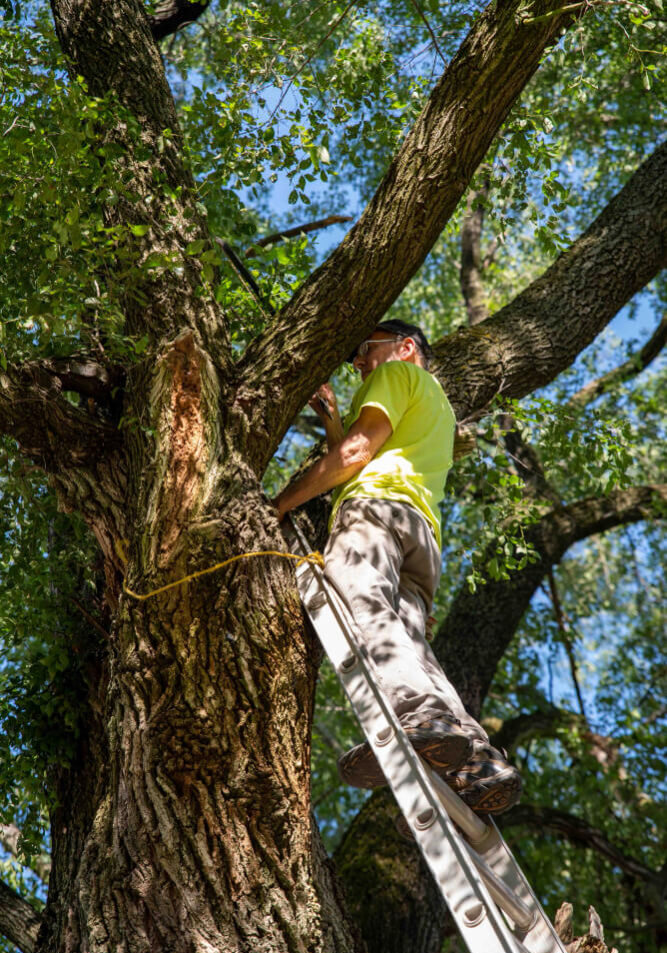
Three families of systems dominate practice.
Dynamic cabling uses synthetic rope systems with built-in shock absorbers and cambium-friendly sleeves. They do not require drilling. They allow controlled movement and reduce shock loads that travel through rigid steel. They also allow the tree to grow around changes in load without stressing hardware. They are ideal for younger to middle-aged trees and for leaders that still need to build more holding wood.
Static cabling uses extra-high-strength steel strand with dead-end grips and thimbles. It reduces movement more than dynamic rope and is the right choice for older, heavier trees where limiting deflection is critical. It does require lag or through-hardware at anchor points.
Bracing rods link the two sides of a weak union. Depending on the wood and defect, we use through-rods with washers and nuts, or lags that seat into solid wood on each side. Larger, deeper defects call for through-rods. It is not unusual to place rods at multiple heights in a single union.
There is no single best system. I pair rods and cables often. For a big red oak with a codominant split forming, two through-rods at staggered heights stabilize the union, then two static cables higher in the crown manage leverage. For a young beech with an immature union but healthy wood, a single dynamic cable may be enough paired with a light crown reduction.
Good candidates for Tree Cable and Bracing
I keep a mental checklist when walking a property. The following situations often benefit from cabling if the wood is otherwise sound and the owner wants to preserve the tree:
- Two or more codominant leaders with included bark at the union, especially when they exceed 8 inches in diameter each and show minor separation. Long horizontal limbs over high-value targets such as roofs, driveways, play areas, or service lines, where reduction pruning cannot fully reduce leverage without disfiguring the tree. Heritage or specimen trees with structural quirks, where the cost of removal and replanting would not replace the character or canopy benefit for decades. Trees that suffered past topping or storm breakage, left with long, weakly attached regrowth that will take years to strengthen naturally. Fruit and ornamental trees with heavy cyclical crops, where seasonal load spikes align with wind or early snow events.
Notice the phrase “wood otherwise sound.” Cabling hardware does not make rotten wood strong again. A Certified Arborist Consultation with sounding, probing, and in some cases a resistance drill or tomography will tell you whether there is enough holding wood to justify the work.
How placement and hardware choices affect outcomes
Installation is not a matter of slinging a rope around a branch and calling it a day. The geometry and attachment method decide whether the system will last and whether it will protect the union you care about.
Height matters. For most leaders, we set the cable about two-thirds of the distance from the union to the tips. Set too low, and you do not control the moment arm enough to make a difference. Set too high, and you move the stress to small-diameter wood with limited holding capacity.
Anchorage matters more. For static steel systems, through-bolts with thimbles https://israelaojs895.bearsfanteamshop.com/residential-tree-removal-services-with-careful-crane-work spread load over more wood and reduce the chance of a lag pulling out. Lags have a place in moderate wood, but a deep, decayed column behind the lag can turn a strong-appearing anchor into a hidden weak point. For dynamic rope systems, cambium sleeves prevent girdling, and proper knots or pre-manufactured terminations avoid slippage. I have inspected plenty of DIY ropes that cinched down and strangled a leader within three years.
Triangulation beats pairs in many crowns. When three leaders compete in a broad-headed maple, one cable between each pair is not always practical. Two cables arranged to create a triangle of restraint can limit multi-axis movement better than a single pair. Each case demands a look at the crown architecture, the direction of prevailing winds, and the targets below.
Hardware sizing follows standards that tie strand diameter and rod diameter to branch size and expected loads. Overbuilding with thicker steel sounds safe, but stiff systems can transfer shock to the next weak link. Underbuilding is worse. If you are hiring the work, ask the crew what size cable and hardware they plan to use and why. The answer should reference limb diameter and span, not just what they have on the truck.
Drilling practices protect the tree. Clean, sharp bits reduce heat and cambium damage. We avoid drilling close to the bark ridge or through visible decay. Sealing compounds have fallen out of favor in most regions because they trap moisture. Sound placement and clean cuts are more important than slathering on a sealant.
Pairing cabling with Tree Pruning & Crown Shaping
Cabling without pruning is like putting a seatbelt on and then driving with bald tires. It helps, but you have not addressed the key driver of stress: leverage.
Load reduction pruning is delicate work. We rarely remove more than 15 to 25 percent of live foliage in a given cycle, keeping cuts small and targeted. On long leaders, we step back the tips to strong laterals, reshaping the crown to compress the lever arms. On codominant stems, selective thinning reduces sail in the dominant side to reduce the tendency to splay. Careful lifts under a roofline or over a driveway can make a dramatic difference in ice storms.
Avoid topping. It explodes future risk. A topped tree responds with a flush of long, weakly attached shoots. The last thing a cabled tree needs is a fresh crop of failure points. Crown shaping should leave the tree looking natural from the street. If you can spot the cuts from a distance, they might be too big or too concentrated in one area.
I often schedule cabling and pruning together. The rope team installs hardware first, then the pruning crew adjusts the load knowing exactly where the restraint points sit. On big trees this coordination scoops a few hours out of climbing time and makes a stronger system.
When cabling is not the right answer
It is tempting to tie up everything. Not every tree should be saved. The hard calls show professionalism.
Extensive decay at the union shows up as soft, punky wood on probing or visible fungal fruiting bodies near the junction. If sound wood depth is below a reasonable threshold, hardware has nothing solid to hold. The threshold depends on species and defect geometry, but you want holding wood measured in inches, not fractions, and the decay pattern matters as much as the number.
Root plate compromise changes the conversation. A tree with a lifting root plate or severed roots on the tension side is a different risk. Cables at 30 feet do nothing for a fulcrum that has given up at ground level.
Leans that formed quickly, especially after a storm, signal a hinge or soil failure. Uprighting and cabling can work in orchards or small trees set with guying systems, but for large shade trees near homes, that is often a temporary fix at best.
Conflicts with FireSmart Tree Services matter on properties in wildfire-prone areas. Trees with crowns touching or ladder fuels beneath them may require spacing and canopy breaks. Cabling to preserve a dense, continuous crown over a roof in a high-risk zone does not serve the larger safety goal. Here, strategic removal combined with replanting the right species at the right spacing beats hardware.
In these cases, a Dangerous Tree Assessment and Removal is the honest path. Owners appreciate clear rationale, not just a quote. When removal happens, pairing it with Stump Removal & Grinding and a replanting plan keeps the landscape whole. The word “removal” sounds harsh until you picture a two a.m. Storm and the bedroom window under that suspect union.
The rhythm of inspections and maintenance
Hardware buys time, not immortality. Trees grow, systems wear, and storms arrive at 3 a.m. Inspections need rhythm, and owners need to know what to watch for between professional visits.
- Schedule a Certified Arborist Consultation annually to check cable tension, anchor integrity, and rod tightness, and after any major wind or ice event. Stand under the union on calm days and sight along the cable. If you see slack where there was none, or frayed synthetic sheathing, call for service. Watch the bark around anchor points. Swelling is normal as the tree adds reaction wood, but cracking, weeping, or fungal growth calls for a closer look. Keep the area beneath cabled leaders free of targets. Park elsewhere during storms, move grills, and shift patio sets out from under the drop zone when high wind is forecast. Pair re-inspections with light structural pruning every two to four years, depending on growth rate and species, to maintain load reduction.
Dynamic ropes have expected service lives. Depending on brand and exposure, plan for inspection at least annually and replacement on the order of 8 to 12 years. Static steel can last longer if installed cleanly and inspected, but bolts, thimbles, and wires corrode eventually, especially in coastal air. I have seen 20-year-old systems still reliable in dry interiors, and 8-year-old systems ready for retirement in salty fog.
What it costs and how projects unfold
Costs vary by city, access, and tree size, but some ranges help with planning. A single dynamic cable on a medium tree might run in the 400 to 800 dollar range. A static steel system with two cables and a pair of through-rods on a large oak could land between 1,500 and 3,500 dollars. Complex crowns with three or more leaders and difficult access can double that. These numbers often include Tree Pruning & Crown Shaping as part of the same visit.
Expect a site visit first. The crew will evaluate the crown, talk through targets, and, if warranted, combine the estimate with a broader risk review. Some municipalities require permits for work near public rights of way. In historic districts, additional rules may apply for heritage trees. Insurance carriers sometimes reduce premiums when documented risk mitigation is in place. Ask for documentation that references recognized standards for tree support systems. In North America, established standards guide cable sizes, locations, and safe work practices. Reputable companies train to those, and they carry appropriate insurance.
On install day, the team will stage tools, set up drop zones, and place climbing lines. Lifts help on open properties, but much work is still done aloft. Expect some sawdust and a little hardware visible if you look for it, though we aim to minimize visual impact. Most residential jobs finish in half a day to a day.
The role of Emergency Tree Services when weather turns
No cable can erase every risk. Storms find weak links. When a cabled leader cracks during a wind event, the cable can prevent a catastrophic peel that destroys the union. It might hold the piece in place long enough for Emergency Tree Services to secure and lower it, sparing a roof. I have seen dynamic systems buy the thirty minutes we needed to rig and remove a broken limb over a garage in sleet, where an uncabled limb would have torn free and punched a hole in the rafters.
After a storm, get a fresh set of eyes on the tree, even if nothing appears wrong. Shock loads can stretch rope or seat hardware deeper. A follow-up visit often involves a wrench on rod nuts and a quick rope retension with a new abrasion sleeve.
Fire, defensible space, and structural support
In regions where FireSmart Tree Services guide landscapes, cabling fits into a broader plan. A well-spaced, well-pruned tree with a supported crown can remain part of a defensible space if it stands away from the structure, ladder fuels are reduced, and the canopy does not overhang the roof. We often cable to preserve separation between codominant stems so we can thin between them, letting light in to the understory while maintaining canopy without dense, continuous fuel paths. Pruning cuts focus on raising crowns above ground fuels, maintaining clearance from chimneys, and reducing deadwood that acts like kindling. Cabling then ensures those remaining leaders do not splay into contact during wind, which can shower roofs with debris during ember storms.
How to choose the right partner
Credentials matter up in a tree. Ask for a Certified Arborist Consultation. ISA Certified Arborists and qualified tree risk assessors bring training in both tree biology and risk evaluation. You are hiring judgment as much as muscle. The same company that offers Tree Removal Services should be equally willing to preserve a tree when the risks are manageable and the wood is sound. Conversely, a team that only wants to cable everything and never recommends removal deserves a hard look.
Ask to see examples of their Tree Cable and Bracing work and to talk through a past project where a cable prevented a failure or, just as important, where they advised against it. Look for companies that integrate their cabling with Tree Pruning & Crown Shaping and offer maintenance plans. If your property includes slopes, defensible space, or shared property lines, choose a team comfortable coordinating with FireSmart Tree Services guidelines and municipal codes.
Finally, ensure they carry insurance and follow safe work practices. Climbing and drilling aloft are controlled risks. I have had homeowners ask to watch from a lawn chair directly under the canopy. We always set a safe buffer. Respect those barriers.
Two field cases that stick with me
A 36-inch diameter red oak, three codominant stems, stood over a century-old farmhouse porch. The union showed a visible seam, and a woodpecker hole on the west side made me nervous. We probed and found a shallow decay pocket but more than four inches of sound holding wood on each side. The owners wanted the shade preserved and were ready to reroof if they had to, but removal would have gutted the character of the place. We installed two through-rods at staggered heights across the seam and two static cables in a triangle at roughly 65 percent height. We reduced sail in the dominant west stem by 15 percent and lifted slightly over the porch. Five years on, after two notable windstorms, the union has callused around the rod washers, and inspection shows no additional opening at the seam. They plan to re-roof next year anyway, on their schedule, not the weather’s.
A mature ornamental pear in a commercial courtyard had been topped badly years prior. Multiple long shoots leaned toward a glass atrium. The property manager wanted Tree Removal Services to be a last resort because the tree buffered afternoon glare. We proposed dynamic cabling high in the crown between the two heaviest leaders, combined with strong reduction pruning to shorten lever arms. We also removed two poorly attached water sprouts rather than trying to prop them for the next decade. A synthetic system made sense here because the leaders still had room to respond, and we wanted controlled movement. Three years later, the tree reads as one cohesive crown from the sidewalk, with fewer storm cleanup calls. The manager added the site to an annual Certified Arborist Consultation plan that also covers Stump Removal & Grinding elsewhere on the campus as plantings change.
A clear path forward for property owners
Start with a walk-around. Identify what matters under your trees: bedrooms, power lines, neighbor fences, the car you park by habit. If you see codominant stems, long horizontal limbs, or old topping cuts sprouting brushy regrowth over those targets, ask for a professional opinion. Tell the arborist whether preservation or replacement better fits your plan. There is nothing wrong with removing a problematic tree and replanting a better species in a better spot. There is also tremendous value in keeping a well-sited tree standing safely for another decade with a thoughtful combination of tree support and crown work.
Tree Cable and Bracing is at its best when it buys time for wood to adapt, protects what sits under the canopy, and complements careful pruning. It is not a silver bullet, and it is not a substitute for honest conversations about risk. Used well, it turns a probable failure into a managed risk you can live with, literally and financially. When it does not fit, swift action through Dangerous Tree Assessment and Removal prevents the kind of night you replay for years. Either way, rely on people who climb trees for a living and who care about the biology inside the bark as much as the hardware they bring up the rope.
Ace Tree Services Ltd.
Name: Ace Tree Services Ltd.Address: 4656 Wallace Hill Road, Kelowna, BC
Postal code: V1W 4C2
Phone: 250-212-9593
Website: https://acetree.ca/
Hours:
Monday: 7:00 AM - 5:00 PM
Tuesday: 7:00 AM - 5:00 PM
Wednesday: 7:00 AM - 5:00 PM
Thursday: 7:00 AM - 5:00 PM
Friday: 7:00 AM - 5:00 PM
Saturday: 7:00 AM - 5:00 PM
Sunday: Closed
Open-location code (plus code): RHF8+8G Kelowna, British Columbia, Canada
Map/listing URL: https://www.google.com/maps/place/Ace+Tree+Services+Ltd./@49.8232606,-119.4337283,659m/data=!3m2!1e3!4b1!4m6!3m5!1s0x537d8b1d074815c5:0x450b88afa7a41435!8m2!3d49.8232606!4d-119.4337283!16s%2Fg%2F11ydkpnh22
Embed iframe:
"@context": "https://schema.org", "@type": "HomeAndConstructionBusiness", "name": "Ace Tree Services Ltd.", "url": "https://acetree.ca/", "telephone": "250-212-9593", "address": "@type": "PostalAddress", "streetAddress": "4656 Wallace Hill Road", "addressLocality": "Kelowna", "addressRegion": "BC", "addressCountry": "CA" , "openingHoursSpecification": [ "@type": "OpeningHoursSpecification", "dayOfWeek": "https://schema.org/Monday", "opens": "07:00", "closes": "17:00" , "@type": "OpeningHoursSpecification", "dayOfWeek": "https://schema.org/Tuesday", "opens": "07:00", "closes": "17:00" , "@type": "OpeningHoursSpecification", "dayOfWeek": "https://schema.org/Wednesday", "opens": "07:00", "closes": "17:00" , "@type": "OpeningHoursSpecification", "dayOfWeek": "https://schema.org/Thursday", "opens": "07:00", "closes": "17:00" , "@type": "OpeningHoursSpecification", "dayOfWeek": "https://schema.org/Friday", "opens": "07:00", "closes": "17:00" ], "geo": "@type": "GeoCoordinates", "latitude": 49.8232606, "longitude": -119.4337283 , "hasMap": "https://www.google.com/maps/place/Ace+Tree+Services+Ltd./@49.8232606,-119.4337283,659m/data=!3m2!1e3!4b1!4m6!3m5!1s0x537d8b1d074815c5:0x450b88afa7a41435!8m2!3d49.8232606!4d-119.4337283!16s%2Fg%2F11ydkpnh22"
Ace Tree Services Ltd. provides professional tree removal, pruning, stump grinding, emergency response, and arborist consultations for properties in Kelowna and across the Okanagan Valley.
The company works with homes, commercial properties, and municipal settings where tree work needs to be planned carefully around buildings, fences, driveways, landscaping, and other site constraints.
Based in Kelowna, the team is positioned to help nearby neighbourhoods and surrounding Okanagan communities with routine tree care and time-sensitive storm cleanup.
Customers looking for careful tree work often want a crew with certified arborist training, insurance, and a methodical approach to higher-risk removals.
Services also include dangerous tree assessment, cabling and bracing, and wildfire risk reduction tree work for properties that need longer-term planning.
To request a quote or discuss tree care options, call 250-212-9593 or visit https://acetree.ca/.
A public map listing is available to help customers confirm the business location and get directions before a site visit or estimate.
For Kelowna property owners who need pruning, removals, or emergency tree help, a local tree service can make it easier to schedule site-specific recommendations and cleanup.
Popular Questions About Ace Tree Services Ltd.
What services does Ace Tree Services Ltd. provide?Ace Tree Services Ltd. lists tree removal, stump removal and grinding, tree pruning and crown shaping, emergency tree service, arborist consultation, dangerous tree assessment and removal, cabling and bracing, and wildfire risk reduction tree work.
Who does Ace Tree Services Ltd. serve?
The company describes its work as serving homes, businesses, and municipalities in Kelowna and across the Okanagan Valley.
Is emergency tree help available?
Yes. Emergency service is listed for downed or uprooted trees, dangerous tree assessment, stabilization work, and branch cleanup. If a tree is near power lines, the safest first step is to stay clear and contact the utility provider before any tree work begins.
Do I always need a permit to remove a tree?
Not always. Permit requirements can depend on where the tree is located and whether it is near a creek, lake, steep slope, or another protected area. It is best to check local rules for the specific property before removal work starts.
How deep does stump grinding usually go?
Standard stump grinding is typically described as going about 6 to 12 inches below ground level, which is often enough for grass or surface landscaping. Deeper grinding may be possible when site plans call for it.
How much of a tree can be safely removed at one time?
That depends on the species, age, health, and structure of the tree. In practice, good pruning is usually about removing the right limbs for health, clearance, and structure rather than chasing a fixed percentage.
What are common signs that a tree may be dangerous?
Large dead limbs, visible cracks, a new lean, root damage, canopy dieback, or storm-related damage can all be warning signs. Trees near structures deserve extra attention when any of those issues appear.
What is cabling and bracing in tree care?
Cabling and bracing are support systems used to reduce the risk of failure in trees with structural weaknesses that may still be worth preserving. They are generally used to add support, not to replace good assessment and ongoing maintenance.
How do I contact Ace Tree Services Ltd.?
Call 250-212-9593.Website: https://acetree.ca/.
Landmarks Near Kelowna, BC
Downtown KelownaThe downtown core is a practical reference point for lakefront neighbourhoods, mixed-use streets, and central residential properties. If your property is near downtown, tree pruning, removals, and cleanup can be planned around tighter access and nearby structures.
Knox Mountain Park
This well-known park north of downtown is a recognizable landmark for nearby homes and hillside properties. If you are close to this area, ask about tree assessment, trimming, or removal work suited to sloped sites.
Mission Creek Greenway
The greenway runs through several parts of Kelowna and is a useful landmark for nearby residential areas. If your property borders or sits near this corridor, site-specific tree planning is especially important.
Pandosy Village
Pandosy is one of Kelowna’s most recognizable neighbourhoods and a common reference point for south-central properties. If you are nearby, request help for pruning, removals, or storm cleanup around homes and small commercial sites.
Rutland
Rutland is a major east Kelowna neighbourhood with a mix of residential and local commercial properties. If you are located in or near Rutland, tree work can be scheduled for both routine maintenance and urgent situations.
Landmark District
This central business-focused area is a practical landmark for offices, service properties, and nearby residential streets. If your site is near the district, ask about careful tree work around parking, access lanes, and built-up lots.
Kelowna’s North End
The North End sits on the edge of downtown and is a useful reference for nearby homes, industrial sites, and commercial properties. If you are in this part of the city, request tree care based on the layout and constraints of the lot.
Airport District
The Airport District is a recognizable north Kelowna reference point for surrounding properties and access routes. If you are in this area, ask about tree services for residential acreage, commercial sites, or roadside cleanup needs.
Glenmore & Dilworth
These established Kelowna neighbourhoods are useful landmarks for central and north-central service calls. If your property is nearby, pruning and removal work can be tailored to mature trees and established landscapes.
Highway 97 Corridor
Highway 97 is one of the city’s main travel routes and a common way to describe location within Kelowna. If your home or property is just off the corridor, a clear landmark reference can help speed up quote scheduling and site planning.